


interview
Published on 15.08.2026
“Sometimes All Someone Needs Is a Hug”
“Oh my God, I’ve just had a brilliant thought,” I say. “Do your Mumushes come as twins too?”
“Yes. And imagine that sometimes they even mix us up,” Eszter says. “Mine crawls into Zsófi by mistake… Or worse: maybe they conspire against us.”
“They hatch their evil plans together,” Zsófi continues, “and then each of them goes after their respective twin. By the time your Mumush comes for you, it arrives alone. But they definitely came up with the plan together.”
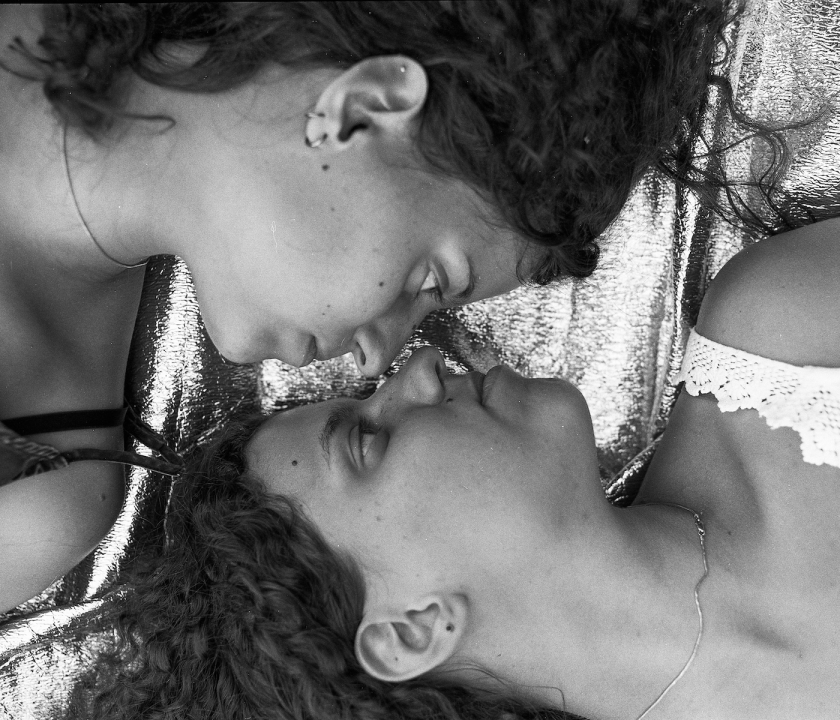
For twenty-two years, Kovács Eszter and Kovács Zsófi have shared a birthday, facial features, communities, and other people’s attention. For them, being twins has meant both an enduring closeness and the struggle to be recognized as two separate individuals. They first arrived at Mumush together, but have since each found their own path: Eszter now works on the legal side of the festival, while Zsófi coordinates the decoration team and the Arts & Crafts programme.
Á: Where are you both right now?
E: I’m working at a camp in Beliș. They’re having dinner at the moment, so I managed to slip away for a bit. I’ve been here for two weeks now - two camps back-to-back.
ZS: I hate you for being there.
Á: And how are you, Zsófi?
ZS: A little exhausted. I’m doing way too many things at once, and it’s a good thing you can only see me, not the five square metres around me. The laptop is propped up against one of my sewing machines, and the other one is right beside it. Everything’s great, I’d just like to spend a month doing absolutely nothing.
Á: Is the whole summer this busy?
ZS: Yes, although I hope not all of it. If September suddenly becomes a complete void, I’ll fall apart from that instead. There’s no winning. You know how it is: whatever’s happening at the moment is always the worst.
Á: All right, let’s get started. I’d like to interview you for the Humans of Mumush series. Have you come across any of the previous interviews?
ZS: In the zines, right? There was one about Kati too.
Á: Yes, in the zines and on the website. Now we’re doing one about you. Are you excited?
E: It’s a little scary. Cool, but scary.
Á: I thought we could begin by having you introduce yourselves separately and talk about what you do. We’ll start outside Mumush and slowly work our way towards it.
E: Zsófi, will you start?
ZS: No.
E: Fine, I’ll go first. I’m Kovács Eszter, I’m twenty-two and a half, and I was born in Cluj - together with Zsófi, except she arrived twenty minutes later. How far back should I go? I should have asked for the questions in advance so I could compose my answers properly.
Á: I don’t actually have a fixed set of questions.
ZS: That makes it more exciting.
E: Ever since I was a child, almost everything I’ve taken an interest in has had something to do with either children or nature. Recently, I’ve started figuring out how to incorporate those things into the professional direction I’m heading in. I graduated from law school, and on Monday I took the entrance exam for psychology. Judging by my result, it looks like I’ll get in. I’d really like those two paths to meet somewhere: law, psychology, and working with children.
Á: Which area of law connects to that?
E: I’m mostly interested in forensic psychology and child protection. For example, how to support children involved in court proceedings, how to make interviews, hearings, and the entire process easier and less frightening for them.
Á: And what kind of camp are you working at now?
E: It’s an adventure camp. Last week the children were between six and eleven, and this week they’re between twelve and sixteen. We go canoeing, play games, sleep in the forest, and spend a lot of time outdoors.
Á: And what are you doing over there among all those sewing machines, Zsófi?
ZS: By October, I’ll have been sewing full-time for a year. I work with all kinds of machines - small ones, large ones, machines with different levels of power - and by now I’ve had the chance to use quite a few exciting ones. Ever since we were children, we went to a lot of scouting, folk dance, and folk art camps, where we learned knotting, made bracelets, and did all kinds of crafts.
Á: Out of all those different crafts, when did sewing become the one that stayed with you?
ZS: I must have been thirteen or fourteen when I inherited a sewing machine from my grandmother. I started experimenting with it: snapping the thread, breaking needles, taking apart the hook mechanism, then putting it all back together. I dismantled that machine so many times that by now I can take apart and reassemble almost any sewing machine.
So I didn’t just learn how to feed fabric under the needle; I also became familiar with the technical side of the machine: the moving parts, the entire mechanism. That’s probably why sewing feels much closer to me than any of the other crafts: I didn’t just get to know one part of it, but how the whole thing works.
Á: At the same time, you graduated in a completely different field.
ZS: Yes, I studied translation with English and German, and Romanian as the target language. I also spent half a year studying in Poland and another half year in Vienna, where I was finally able to take some classes with Hungarian as the target language as well.
I really loved the field, and I learned a great deal from it - not only professionally, but also from having to manage on my own in different countries and different languages. University was also important because it allowed me to separate from Eszter to some extent. For us, that didn’t happen suddenly in our teenage years; it was a much longer process. University made it possible for us to actually have separate lives.
Á: How does it feel, at twenty-two and a half, to have someone whose life has been so closely intertwined with yours from the very beginning?
E: Whenever someone asks me what being a twin feels like, the first thing that comes to mind is that, for a very long time, I was never alone. Of course, siblings with a small age gap also grow up together, but we reached every milestone at the same time, celebrated our birthdays together, and always socialised in the same communities. Even when we found ourselves somewhere unfamiliar, I still had a fixed point beside me: someone I had grown up with and loved very much.
Á: When did the more difficult side of that begin to appear?
E: Probably when I started wanting people to treat us as separate individuals. Meeting someone new was never like, “Hi, I’m Eszter, and I like chocolate biscuits.” It was always, “Hi, I’m Eszter, and this is Zsófi. I have a birthmark here and she doesn’t; my hair tie is yellow and hers is pink.”
People always defined us in relation to each other, and for a very long time, that was the only way I knew how to define myself too. It wasn’t only that I struggled to see myself as an individual - the people around me did as well.
Later, I wanted people to remember me for something other than the fact that I had a twin sister. I didn’t want them to have to look for the birthmark or check the colour of my hair tie. I wanted them to have some other point of reference - something that would let them know it was me without even having to look at me.
But more than anything, being a twin has always meant having someone I love very much, someone who has always been there beside me - and whose name I sometimes answer to as well.
ZS: The name thing really is strange. Even now, it still feels unfamiliar when someone addresses me as “Zsófi.” I’m still getting used to being called by my own name, because growing up we were always just “the twins.” The twins said the funny thing, the twins were being mean, the twins had done something wrong.
Á: So you received attention as a pair as well?
ZS: Yes. The attention someone normally receives when they enter a new social group was something we received together. We then had to make an extra effort to receive genuine attention separately as well. I think that eventually created frustration in both of us. We started competing with each other and trying to outdo one another, because we both wanted to be visible as individuals.
Á: Does knowing each other so well make your conflicts more intense too?
ZS: Of course. You know the other person so well, and your souls are so closely intertwined, that you know exactly where to hit them where it hurts most. Not in some half-hearted way, where you just insult them a little. You can say something that genuinely causes a lot of pain. Precisely because you’re so close.
But all those stories about twin telepathy can be dropped, honestly. It’s a bit like saying Transylvania is Dracula’s home. Everyone always asks whether we have the same dreams, or whether one of us feels it when the other gets hit.
Á: Oh my God, I’ve just had a brilliant thought: do your Mumushes come as twins too?
E: Yes. And imagine that sometimes they even mix us up. Mine crawls into Zsófi by mistake… Or worse: maybe they conspire against us.
ZS: They hatch their evil plans together, and then each of them goes after their respective twin. By the time your Mumush comes for you, it arrives alone. But they definitely came up with the plans together.
Á: Did you arrive at Mumush Festival together as well, or did one of you bring the other along?
ZS: Together. I think we first went in 2022, just as festivalgoers. We knew several people who either worked there or had already been, and everyone kept saying it was great. So we thought, let’s go and see whether it really is. And it was.
The following year, we came back as volunteers, but in different departments. I started in Construction, and Eszter was originally going to join me there.
E: But then I broke my ankle.
ZS: Yes, she shattered her ankle, so she ended up in the Decoration team instead. A year later, I joined them too. By then, Eszter had already been involved in the year-round planning, and she told me I should come over as well.
Á: How did that eventually turn into a coordinating role?
ZS: I spent my first year as a crew member, and then last year I also took charge of Arts & Crafts, which is part of the daytime workshop programme. I was the one emailing all kinds of hippies to find out what sort of crafty little activities they wanted to run. During the festival, I also coordinated the handovers: one workshop finishing, the next one starting, people setting up, packing away, shaking hands, passing the space on.
Then, from November, I worked as a co-coordinator of the Deco team, and from May onwards, things worked out in a way that left me running it on my own.
Á: Eszter, you also started in the Decoration team, but ended up somewhere very different.
E: Yes, my path was probably less winding. I started in Deco and worked on all kinds of smaller and larger projects until February. I had projects of my own too, although I’ve never been as good with my hands as Zsófi.
Then I told Hunor (ed.: one of the festival’s main organisers) that I had spent four years studying law, and that if there was anything I could help with using that background, I would be very happy to do it. At one point, he asked me to look something up. I did, and I really enjoyed it.
Á: Is that how you became the legal advisor?
E: Yes, although I don’t really like thinking of it as a position. At some point, what I was doing simply acquired a name, applications opened, and I applied. Now I deal with the legal matters behind the festival: permits, contracts, wording, and figuring out what the legally appropriate next step is in certain situations. I try to live up to the title of legal advisor.
Á: How much did university prepare you for that?
E: For these specific tasks? Not at all. My legal background mainly helps me understand legislation more quickly, know where to look, and notice when something doesn’t seem right. But I had never previously been in a situation where I had to draft a contract myself, for example.
So the whole thing became a separate learning process. I had to work out which laws applied to which questions, I made spreadsheets, and when I didn’t know how to draft a particular contract, I dug twenty different templates out of the deepest corners of the internet, compared them, and then wrote one of my own.
That’s mostly what I’ve been doing lately. I still help Zsófi with the occasional crafty task, but I’ve basically moved from the field into the back office.
Á: What was it that truly drew you to Mumush? What made it become more than just a festival for you?
ZS: I find it really exciting that we belong more or less to the youngest generation in the community. There are a few people younger than us, but most are five, ten, sometimes even fifteen years older. When we first volunteered, our first mutual friend was Kobzi, who could practically be our father. He was the first person who sat down with us and somehow took us under his wing.
Another thing I find really interesting is that I often have no idea how old someone is or what they do for a living when I first meet them, because somehow it just isn’t relevant.
Á: What is it like being part of the community as some of its younger members?
ZS: We were always taken seriously. I could say things that made them think too, while at the same time learning a great deal from their experience, from the way they work, the way they exist within a community, and the way they relate to the world and to life.
Á: How does someone gradually come to take on more responsibility?
ZS: Very organically. It isn’t a corporation where you climb a ladder and move up one level at a time. Here, you can try out what you want to do and search for your own path while gradually taking on more responsibility. Eventually, it simply becomes clear who is ready to take on more and how each person can contribute to the whole.
People of very different ages, from different worlds and places, with very different experiences, all come together - and together they create the beauty of what happens there.

Á: Eszter, what has been your strongest experience of this community?
E: From the very beginning, I felt that whenever I sat down to talk to someone, I didn’t just get to know them better, I also learned something about myself. A question or thought would always come up that I hadn’t considered before, sometimes something I happened to need in that particular moment of my life. Whoever I sit down with, I feel that I can ask them things, and that they are genuinely curious about what I do as well.
There have been several times when something was worrying me, or I didn’t understand what was happening to me, and during a conversation I suddenly found answers. Not necessarily ready-made solutions, but something that helped me look at the situation differently.
Á: What changed once you began taking on responsibility yourself?
E: That was when I really began to feel the supportive power of having room here to make mistakes, ask questions, and learn. I’m not expected to know everything. What is expected of me is that I ask when I don’t know something.
Whenever I asked a question, I received a thorough answer, and I was usually encouraged to keep asking. That often motivated me beyond Mumush as well. There were times when I rushed through all my other tasks just so I could get back to my Mumush work, because this intense learning process had become so important to me.
I saw what happened when someone else made a mistake, and I saw what happened when I made one. What followed wasn’t humiliation or punishment, but something you could learn from. That gave me a sense of safety I had experienced in very few other communities.
Á: What makes that sense of safety so special?
E: Maybe the way people live together. Here, people often spend not just a few days together, but weeks or even months. And yet there is a kind of mutual respect, care, and understanding between them that I haven’t really experienced elsewhere. For me, that is one of the most important parts of it all.
Á: Is there a particular memory from Mumush that has stayed with you?
E: The first year, we were only there as festivalgoers, and the whole thing was great fun. But when I think about my first real experience of the community, I count it from the first time we went as volunteers.
That summer, I broke my ankle. My leg was in a cast for six weeks, and then for another six weeks I wasn’t allowed to put any weight on it. I went to physiotherapy, rehabilitation, all kinds of treatments - basically, I had to learn how to walk again. The accident happened in May, and when we left for build week in August, I was still using crutches.
At the time, neither of us had a driving licence or a car, so we took the train from Cluj to Târgu Mureș. We arranged for someone to pick us up from there and drive us to Adorján. At the station, we put my crutches in the car, and when we arrived, everyone got out, there were hellos and introductions, new faces everywhere - and the crutches stayed inside the car, which had meanwhile been parked somewhere far away.
When it was time to move from one place to another, I suddenly realised I had nothing to walk with.
Á: What did you do?
E: I started walking without them. And I realised it worked. It was the first time in twelve weeks that I had walked without crutches. After that, we didn’t even take them out of the car for the rest of the festival. I spent the whole week walking up and down the field, and it felt incredibly liberating.
Even now, whenever I return to Adorján after being away for a long time and step out onto the field, I think of that moment. It always feels a little like walking without crutches again: the same sense of freedom. I find it really beautiful that the place has continued to mean that to me ever since.
Á: Zsófi, what was your first defining Mumush experience?
ZS: Answers to questions like that always come to me afterwards. If someone asks me about the coolest moment of my life or my favourite book, at first I can’t think of anything, and then later a hundred things come to mind. Even now, I can’t pick out one single moment from the whole story.
Á: Then let’s start with something you made. Out of all the decoration projects you’ve worked on over the years, which one has meant the most to you?
ZS: Last year, I found a box of leftover faux leather in the Deco house from an old project. I thought they could be turned into some great floor cushions, because at the festival there’s never anywhere comfortable to sit.
Since there were only small scraps left, I designed a round cushion with a top made from eight panels. For the bottom, I sewed the leftover strips together, cut a circle out of them, and added a zip so the cushion could be filled with straw. At the end of the festival, you can empty them, use the straw elsewhere, and store the covers in a very small space until the following year.
In the end, I made twenty smaller meditation cushions for Healing and another sixteen larger ones for different festival areas.
Á: How long did you work on them?
ZS: I spent two weeks in Adorján sitting beside the sewing machine. It was more of a personal project than something belonging to the whole Deco team. I handled the entire process, from the design and the first prototypes all the way to the finished cushions.
The beginning was really exciting: coming up with the pattern, sewing the first one, seeing that it actually looked good. But when you then have to make another sixteen, twenty-six, or thirty-six of the same thing, you die twice before you finish. I’m much more interested in experimentation and making the first prototype. Repeating the same thing over and over is much less exciting.
Á: What made you finish them anyway?
ZS: I had to discipline myself. I leave a lot of things unfinished, so this also became an exercise in perseverance. I decided that this time I would finish what I had started.
Meanwhile, everyone kept joking that the cushions would be stolen during the festival. Hunor and I even made a bet: if more than ten percent of them disappeared, I would owe him a bottle of very expensive whisky. In the end, not a single cushion went missing, so I won and he gave me a bottle of Tubi.
By the end, it became a very satisfying project. Not only because the cushions turned out well, but because I completed something I might otherwise have abandoned once it became repetitive. That’s why it means so much to me.
Á: As a coordinator, what gives you a similar feeling?
ZS: I really love watching someone enthusiastically pick up a paintbrush, a can of spray paint, or any other tool and start creating something with it. It’s exciting to see how different people approach a task, what they put into it, and what they take away from the experience.
Á: When you think about your future, where does Mumush fit into it? Can you imagine remaining part of it in the long term?
E: Absolutely. I’d like to keep working on the things that have recently come my way for quite a while. I haven’t been doing them long enough for everything to feel instinctive or for me to have an immediate answer to every question.
At the moment, a question usually comes up, I spend three to five days reading about it, and only then can I answer. I’d like to reach a point where I have enough knowledge and experience in certain areas to understand more quickly what needs to be done.
For that to happen, I need to continue having room to learn here, while making sure that what I learn is also useful to the community.
Á: Zsófi, do you also naturally assume that you’ll continue?
ZS: Yes. Mumush is a project that develops together with the community. It moves in the direction we lead it, while we also grow within it and through it.
I think that if we continue making a place for ourselves in it over the long term, then there will be a place for us. For me too.
Á: What could make that more difficult?
ZS: My own projects are beginning to take off, and my life is starting to settle into a certain routine. That probably means I won’t be as free as I used to be. I may no longer be able to get into the car on a Wednesday and stay in Adorján until Sunday, because I might have to work until Friday.
Sometimes I wonder how to bridge that gap. How do I preserve my motivation and continue taking responsibility if I can’t be physically present in Adorján for long periods?
Á: Do you see people around you who manage to do that?
ZS: Yes, and that reassures me. There are many people around me who are grown-ups with grown-up jobs, earning grown-up money, and they still manage to remain an integral part of this community and the project.
Sometimes I panic a little about what will happen when I no longer have endless time to volunteer. But Mumush will also keep changing and branching out in different directions. I’m not afraid that one day there simply won’t be a place for me in it.
Á: What would you like to give to Mumush - to the festival and to the community?
ZS: Whatever it needs at that particular moment. I think it’s important to notice what a situation calls for and, as far as possible, to offer exactly that.
You don’t always have to overthink it. Sometimes all someone needs is a hug. Other times, they need you to stay quiet. Or they need you to solve a problem that someone else can’t deal with, doesn’t want to deal with, or simply doesn’t have the capacity to handle.
Á: How do you know what is needed?
E: I don’t think you should always wait for someone to tell you what to give or what to do. It’s good when you can notice it yourself.
If everyone understands what is needed and what they personally can contribute to it, then we’ve already made a lot of progress.
Á: Is there something you personally would like to pass on from what this community has given you?
E: A sense of safety. I feel very safe in this community. There are specific spaces for that too, such as the women’s circle, where the women in the community gather and talk about certain things in a safe environment. But that is only one part of the safety I feel here. Different people and different experiences have become points of stability for me.
So if you ask what I would like to give, perhaps it is the chance to become that kind of safe point for someone else. I don’t want to be the only one who comes here longing for something, receives it, and then falls asleep comfortably with a smile whenever I think of this place.
interview by ádám